Featured Post

The Great Pricing Shift: How AI Is Breaking Traditional Revenue Models

------ 1. The Great Pricing Shift We're witnessing something unprecedented in business history: a fundamental reimagining of how comp...

Monday, August 01, 2022

Top 10 Artificial Intelligence Companies in Media Ecosystem

Top 10 Artificial Intelligence Companies in Media Ecosystem 
  • Appier 
  • GumGum 
  • Sizmek by Amazon 
  • IBM Watson 
  • Dstillery 
  • Invoca 
  • Influential 
  • Quantcast 
  • Heuritech 
  • NetBase Quid 
More details here

Sunday, July 31, 2022

Weekend Reading


Ten Rebranding Do’s And Don’ts 
  • Do re-imagine your business beyond the logo. 
  • Do gain support from the C-suite. 
  • Do get internal as well as external insights. 
  •  Do keep it real. Do bring in all key stakeholders. 
  • Do leverage the opportunity to drive broader change. 
  •  Do over communicate. 
  •  Do keep it aligned. 
  • Do make sure your people can deliver. 
  •  Do find the right partner. 

Close to two-thirds (64%) of all the marketers surveyed are currently using artificial intelligence (AI). A full 60% say they have a fully defined AI strategy. This year, the leading use case for those marketers using AI is to drive next best actions, followed by personalizing the overall customer journey and automating customer interactions. 


 How to Win over a Team of Experts Try these three strategies: 1. Look inward to the team. Your success will depend on your ability to build interdependence and cooperation among team members. Focus on the team itself and see whether you can find ways to improve communication, interaction, and debate. Aim to create a group whose members learn to rely on each other and are less dependent on you to be involved in every decision. 
Exercise: Identify a decision you believe the team can make (it should not be a decision regarding a crisis situation). Use team meetings to work on the decision. Solicit input from everyone without allowing debate on the ideas. Summarize what you have heard from the team. Redirect the team to focus on the core areas, then encourage debate. 

 2. Look outward to the organization. Seek ways to resolve the team’s problems with the broader organization. Examples include things as simple as securing a budget, getting top-management backing for a project, or winning the cooperation of another department. 
Exercise: For a current team challenge, list the people you know in the organization who could provide any of the following: additional information or perspective that could help the team or shift its perspective; access to individuals who could support the team by doing small tasks, or people who would like to be involved in solving the problem; and bridges to other groups or stakeholders. Then use your network to tap those resources. 

 3. Look to build team members’ reputations. Although this strategy doesn’t specifically address a pain point, it still shows employees that you have their backs and are interested in their career development. Help team members expand their networks and their perspectives. With a broader network, a team member can more easily address his or her pain point and bring new perspectives to the team’s challenges.
Exercise: For each team member, list two to three people who would value knowing of that individual’s experience, perspective, and capabilities. Use your connections to set up one meeting for each employee. Coach the individual on how to best manage that meeting. Check on the impact the team member had.


The goal, according to a recent PCW report, is to get beyond titles and delve into attitudes and behaviours. That’s the approach that leads to more relevant communication, rewards, performance and development, the report reads.


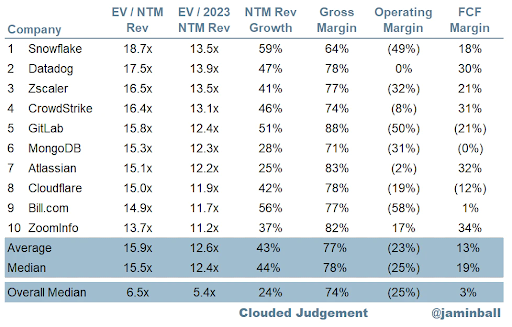
SAAS Companies Growth Valuation “Not all software is created equal. Software businesses that don’t have a short term path to FCF (call it <2 years) have gotten wacked in the public markets. But, just like pre-2015 when the market assumed software wouldn’t turn profitable, the same thing is happening now. With a longer term horizon we’ll see many software companies turn profitable. The important task is finding the businesses that can turn profitable, while maintaining attractive top line growth. That “holy grail” combo will be a smaller percentage of software businesses – ones growing >20-30%, with FCF (free cash flow) margins >20-30%, with annual revenue >$1B. Final thought - what gets me so excited currently is that we’re seeing companies still in hyper growth mode, at a scale of ~$1B ARR+, hit mature FCF margins. Crowdstrike (>60% growth, ~30% FCF margins), Datadog (>80% growth, ~30% FCF margins), Snowflake (>80% growth, ~20% FCF margins), ZScaler (>60% growth, ~20% FCF margins), and ZoomInfo (~60% growth and >30% FCF margins) all have incredibly impressive profiles. 

Top 10 EV / NTM Revenue Multiples


Friday, July 29, 2022

How to Influence your Buyers for Cloud App Modernisation

How to Influence your Buyers for Cloud Application Modernisation

Cloud Offerings for Application Modernisation


Buyers Persona Mapping with Cloud Offerings for Application Modernisation to execute the Sales Strategy 


Thursday, July 28, 2022

Eight Steps for Every CFO to Apply in Recession

 Eight Steps for Every CFO to Apply in Recession

-

  • Prioritisation - Make a prioritised list of the trade-offs in your budget with a reason for why.
  • Cloud - Accelerate movement to the cloud, while paying attention to shifting pricing strategies from software providers as prices rise.
  • Business Process - Radically challenge workflows and processes to make them faster, simpler, and more agile for the long-term.
  • Leverage and Cost Arbitrage -  Fundamentally rethink the way your company leverages humans (locations, hours, part vs full time, in-house vs outsource).
  • Digital Talent - Clarify your Employee Value Proposition (EVP) so you are positioned to attract and retain the right digital talent. Aggressively source key digital talent that will shake loose and help accelerate your digital plan
  • Digital Investment Roadmap - Develop a future vision of the customer and employee to accelerate the right digital investments for 2025.
  • Automation - Invest in predictive and autonomous digital projects that will make the organization faster and leaner.
  • Measure and Focus - Narrow the metrics you use to measure and manage digital initiatives to the few that align with outcomes.

Source  Gartner, BCG, Mckinsey, HBR

Why Cloud - Reality vs Perception, Impact on IT

 Why Cloud is in Demand


Cloud - Reality vs Perception


Impact on IT


Tuesday, July 26, 2022

Telecom Cloud Evolution, Use Cases and Infrastructure Market

  • Telecom Cloud has evolved from an early infrastructure offering to a solution-centric and to being an aggregator. 
  • Telecoms are struggling to get ROI in this domain while the sector is still growing by 30-35% YoY. 
  • Players Like AWS, MSFT, Google, Dell (EMC/Vmware), IBM and others are not letting Telecoms to play in this space. Besides Telecoms with so many customer-centric assets are struggling to refine their operating model to take advantage of the cloud to diversify and increase revenue.


Telecom Cloud (Distributed) Use Cases 


Cloud Infrastructure Services Market - 2022


Why Cloud


Cloud Sales Roadblock


Saturday, July 23, 2022

Weekend Reading

Digital Business Ecosystem Under The Hood 
In an ecosystem, we typically see three types of horizontal business models emerge - Aggregators, Integrators, and Infrastructures - which may be distinguished based on their position in the value chain. Additionally, firms may specialise and act as capability providers.

Five Anxieties of Tech CEO
  • The first is dealing with increasing individual and team performance. Technology moves at such a rapid pace that is challenging to keep up with evolving new concepts. 
  • The second is with doing more with less – either with resources (people and budgets) or time to meet the company goals. 
  •  Most technology organisations have developed specializations over the years and the CEO experiences the third anxiety of leveraging with partner organisations as specializations are all over. 
  • Often, either the organization, the investors or the board has a new vision, and the CEO now needs to deal with the fourth anxiety of how to synchronize one’s execution with a new vision. 
  •  Finally, the technology world has grown global and technology teams take the job to where the talent is. This now means managing and leading the global workforce, the fifth anxiety.


“Don’t hope to impress customers with the language they won’t understand. Instead, impress them with how much you understand them,” the post said. “The reality is that jargon varies so much from organization to organization – and even from department to department inside of an organization – that it’s always better to speak in plain terms than to risk fanciful obscurity.”

Replacing the Sales Funnel with Flywheel 
Using a flywheel to describe a business allows us to focus on how to capture, store and release our own energy, as measured in traffic and leads, free sign-ups, new customers, and the enthusiasm of existing customers. It’s got a sense of leverage and momentum. 
The metaphor also accounts for the loss of energy, where lost users and customers work against our momentum and slow our growth. 
The two dynamics that make our flywheel spin fast: are force and friction.  


Monday, July 18, 2022

Saturday, July 16, 2022

Weekend Reading


  • Key to Building a Great Company
    • Do the hard things. To build a great startup, you have to move fast. But you shouldn’t let urgency distract you from tackling big, thorny problems. Doing the hard things is one of the most effective ways to build true defensibility. 
    • Protect your principles. Having clear company principles helps your team make faster, better decisions. It’s easier to act autonomously when you have a clear framework to follow. Failing to protect these values can shift your company towards an “exception-based” culture. 
    • Pay your debts. Every time you make a sub-optimal corporate decision, you create a “debt” that must be paid. This is true across engineering, product, and marketing teams. To avoid debts spiraling, keep track of them and proactively pay them down. 
    • Build a brand. If you’re building a good business, you’ll inevitably attract competition. For consumer companies, it’s essential to create an impactful, differentiated brand. If you do it well, you’ll outcompete better-capitalized opponents.”
  • Career Advice
    • Try to be the best at what you do. The money will take care of itself…In business, persistence pays off…Others may have more advantages than you, but no one has more hours in the day than you. No one can outwork you unless you let it happen…Find your workplace tribe…No one cares about your disadvantages. Overcome them…Managers must be managed.
  • Action for Sales Leader When Inflation is Rising
    • Actions - Once you and your peers have assessed the market landscape and your ecosystem, take action. Incorporate immediate actions into existing sales plans and future required actions into your B2B sales strategy. 
    •  Leadership Actions 
      • As with all changes that affect our teams, we must take a leadership role. For example, we must treat economic downturns and the changes that we have to make as a comprehensive change program. As usual, this starts and continues with communication. 
      •  Communication. When economics impacts our business, our teams and those within our partner ecosystems need reassurance about the future of the company. In addition, they need reassurance of their personal futures. Share executive team views on the market. Communicate the results of any assessments that have been made and actions that are planned. 
      • Care for your team. Managers must ensure that open and transparent communications are available. Continue to appreciate and recognize employee efforts during what could be a challenging time. A culture of appreciation drives employee engagement and productivity. 
      • Budget. Although sales does not have tremendous discretionary budget, it goes without saying that leaders must reduce all unnecessary spending, including travel, and consider hiring freezes where appropriate. 
    • Go-To-Market Actions 
      • Position resources toward the market priorities that will drive the best current and future results. For example, some industries such as healthcare may be more recession-proof than others. 
      •  Demand engine changes. Shift marketing spend to appropriately drive demand in target segments and nurture those that will be poised to act when recovery occurs. Share Six Tips Marketing Operations Leaders Can Use To Prepare For A Potential Recession with your marketing partners. 
      • Digital routes to market. Consider how buyers may be changing their purchasing behavior. If, for example, they desire self-service, consider if now is the time to invest in digital selling capabilities. Doing so can meet buyer needs and reduce human sales expense. 
      • Seller enablement. Educate direct and partner sellers on new messaging, offerings, packages, etc. In addition, coach them to ensure that they can effectively leverage these resources. 
      • Coverage and quota. Shift coverage to ensure that existing and targeted priorities are effectively covered. Consider changes to quota or incentives to drive action to the highest-potential opportunities and clients. Also, consider how quota or incentives may have to be adjusted if existing targets are no longer achievable. 
  • Define ROI from Digital Transformation 
    • Example - Insurance 
      • Once the link between digital capabilities and customer and business metrics has been established, begin to map these digital capabilities to the customer lifecycle, the insurance value chain, and a technology stack. 
      •  Demonstrate how digital technologies: Improve product design, marketing and sales, service, and engagement. 
      • Lower the costs of underwriting, acquisition, service, and compliance.
  • 12 Best Sales Methodologies & The Key to Customer-Centric Selling
    • SPIN Selling 
    • N.E.A.T. Selling™ 
    • Conceptual Selling 
    • SNAP Selling 
    • Challenger Sale 
    • The Sandler System 
    • MEDDIC 
    • Solution Selling 
    • Inbound Selling 
    • Target Account Selling 
    • Command of the Sale 
    • Gap Selling

Friday, July 15, 2022

Global Financial Crisis to Global Inflation Crisis Spectrum

 Global Financial Crisis (GFC) to Global Inflation Crisis (GIC) Spectrum


Inflation Impact - CIO and CFO Ask and Priorities in 2022


CIO Priority for OPEX Relief by Reducing Spend on 

  • Collaboration software 
  • Data centre build-out 
  • Consulting 
  • Infrastructure hardware 
  • ERP applications

CIO Priority for driving Growth by Increasing Spend on 

  • Digital transformation 
  • Cloud, AI, ML, RPA
  • Cost Arbitrage levers like Outsourcing and Offshoring
  • Data warehouse, Business intelligence, Analytics
  • Security software 


Wednesday, July 13, 2022

Elon Musk Effect on Twitters Business and Brand Equity


Effect on Share Price, Twitter Business, Employees, CEO and Exec Team
  • Elon Musk who leads Tesla and Space X announced buying Twitter for $44 Bn supported by venture capital firm Andreessen Horowitz, the crypto exchange  Binance, and Oracles CEO Larry Ellison. This helped the falling share price to rise again. 
  • On July 10 he announces to pull out because of a lack of clarity on users (primarily bots) and financials and since then the price has fallen back to the same price of $33 when the deal was announced to acquire.
  • Prior to this deal, the share price was in decline from early 2021.
  • It is likely that it now goes into litigation and worst for Musk will be to pay $1Bn in the penalty, but it has a detrimental effect on Twitter's business, employees (morale), and more importantly, its brand equity will take a severe hit, resulting in further decline.
  • Twitter CEO and his executive team will not survive this fiasco.


Trends from AT&T about Fibre Economics and Data Growth

Key Trends and Message from AT&T Results from Mar 2022

  • Monthly consumption is accelerating from 900 gigabytes to nearly a terabyte today.
  • We are consuming roughly 30x more data in our homes than we are on the go with our smartphones. 
  • Homes are getting smarter, and they're becoming more demanding environments where flawless, high-quality broadband is required. Our home has become a work environment.
  • The average household today has 13 devices, and that's expected to triple by 2025.
  • Enterprises are managing a multi-cloud environment they require more low-latency and secure bandwidth.
  • Fibre is economical and superior; therefore, consumption over wireless is used for high-value mobile applications. 
  •  IoT connectivity is growing 18% year-over-year. The next wave of digital transformation is being driven by cloud, AI and connected sensors.
  • Data growth is exploding post covid driven by hybrid arrangements, pent-up demand and everything digital.
  • Fibre is not only economical with data demand but is superior, reliable and secure. 

Suggestions for the Federal Govt on NBN.
  • Make 250/100 Mbps the minimum speed requirement on the network. Currently, Avg speed in Australia is around <60/20Mbps
  • Waive off the outstanding debt of $27Bn, and that will enable NBN to reduce the wholesale price to around $20-$25/month per user
  • Make FTTP to all areas (>93%) where it can be served.
  • These 3 suggestions will drive the green economy and innovation, reduce carbon footprint, reduce pressure on the city's infrastructure, drive growth in country areas and drive SMB growth and reach outside Australia. 


Thursday, July 07, 2022

Persona Mapping - Sellers from Mars and Buyers from Venus - Elements of Nature Meet B2B Sales

Excerpt from my upcoming book at amazon.com - "Sellers from Mars and Buyers from Venus - Elements of Nature Meet B2B Sales" 

How a Sponsoring Executive of Action Centric (Fire) Persona and Calm and Stable Persona (Earth) will engage with others. 

-----

Sponsoring Executive


An executive sponsor is a person in the management or an executive team responsible for driving the outcome of a proposed solution to resolve a business problem. In business-to-business sales, an executive sponsor can be on either side, at the buyer's or the seller's end. 


At the buyer's end, it is primarily someone who has a keen interest in resolving a business problem or is a decision-maker and strongly influences the outcome of a sales transaction. 


At the seller's end, it is primarily someone keen on growing the business by investing capital and resources.


Following are the key responsibilities of an executive sponsor at the buyer's end:

Prepare and own the business case

Engage and work with other sponsors and stakeholders in positioning and selling the business case internally and externally with suppliers

Recommend or assist in the go-to-market approach

Govern the communication with stakeholders

Govern the risks and the outcome of the business case 


Let us explore how a sponsoring executive at the buyer's end engages with the internal and external stakeholders by applying the elemental attributes learned in previous sections.


Fire – Action 


Sponsoring Executive


Business Case Preparation

o they are seeking a futuristic and innovative roadmap or a solution, preferably for short and mid-term 

o a lot of data points are provided for analysis and problem definition

o budget allocation will be generous and is eager to allocate work   


Go to Market Approach 

o fond of an audience and connecting with higher authorities means they employ a top-down strategy

o being time-consuming, a mechanism like RFP is least appealing 

o they reach out to innovative and agile (swift in delivery) suppliers, or internal teams for selling the business case


Positioning 

o growth-oriented – being passionate for innovation and driven by future trends with the intent of growing the business, their initiatives are positioned as growth-oriented


Engagement

o being open and honest, they interact with honesty and transparency, loses cool if the opposite side is not transparent

o the sharpness of fire is reflected in their sharpshooting style of conversation, and they have no hidden agenda

o they are competitive and use charm to impress upon stakeholders 


Communication  

o timely, quick and action-oriented

o they lack depth in conversation, like to take control of the conversation 

o they use data-driven insights and visuals to communicate  


Governance   

o they exert pressure on stakeholders by repeatedly chasing activity progress 

o they seek action and quick wins 

o they are tolerant and considerate but will have failures or lapses in execution provided the information for the root cause is shared transparently


The book is on promotion for a limited time only.


Wednesday, July 06, 2022

Sellers from Mars and Buyers from Venus - V

Excerpt from my upcoming book at amazon.com - "Sellers from Mars and Buyers from Venus - Elements of Nature Meet B2B Sales" 

How a Marketing Manager will engage with others 
--

B2B Sales Stakeholders and Their Activities

The sales team or a sales representative, engages various internal and external stakeholders, with the intent of growing the business underpinned by positioning a compelling product or a service. The following list gives a good view of various stakeholders engaged by the sales team or a representative.
the internal marketing and corporate strategy team for research, positioning, and pricing 
internal product engineering or service design team 
internal legal service team for defining contractual agreements, terms, and conditions
procurement at the buyer’s end
sponsoring C-level executives like CEO, CFO, CIO, CDO and their team members at buyer’s end
internal HR, legal, quality, security and sales team  
and others like a third-party product or service partner 

These stakeholders will vary with vertical, geography, type and size of a prospective buyer like an SME or a global player. This is not an exhaustive list but highlights the magnitude of complexity and multiplicity involved in executing sales and business development activity. 

With the intent of supporting a sales team or a representative, different activities at each stage of the value chain are executed by various stakeholders, some in parallel and some in sequence. 

Let’s explore how a Marketing Manager will engage in various activities with its stakeholders at the seller's or buyers' end by applying the lens of five elemental attributes.  


--

Next: Coming up 
  • Cheat Sheet for Sales Planning and Execution using Five Elements   
  • How a Procurement Executive will Engage
  • How B2B Sales are different in Service vs Product 
--
Previous articles can be read here
  • Part 4 on How a Sponsoring Executive will engage can be read here
  • Part 3 on Negotiation Styles in B2B Sales can be read here 
  • Part 2 on Persona Mapping in B2B Sales can be read here 
  • Part 1 on Marrying Elements of Nature with B2B Sales can be read here

Tuesday, July 05, 2022

Market Your Way to Growth

Template for driving growth.
  • Grow by Building Market Share 
  • Grow through Developing Committed Customers and Stakeholders 
  • Grow by Developing a Powerful Brand 
  • Grow by Innovating New Products, Services, and Experiences 
  • Grow by International Expansion 
  • Grow by Mergers, Acquisitions, Alliances, and Joint Ventures 
  • Grow by Building an Outstanding Reputation for Social Responsibility 
  • Grow by Partnering with Government and NGOs

Characteristics of Creative People

Personal Characteristics 
According to Gilda Waisburd, a specialist in creativity, the traits of creative people are as follows:3 
• Flexible (they go beyond the obvious) 
• Fluid (they generate many ideas about a problem) 
• Elaborative (they expand the task in detail) 
• Tolerant of ambiguity (they stand up well to conflict) 
• Able to see the whole (they take a systemic approach) 
• Inquiring (interest in many disciplines) 
• Sensitive to the interests of others (they understand others’ needs) 
• Curious (interested in “playing” with things) 
• Independent (they come up with ideas of their own) 
• Reflective (they think about what they see and hear) • Action-oriented (they go beyond thinking and the idea to act) 
• Able to concentrate (they work in a consistent manner) 
• Persistent (they don’t give up easily) • Committed (they get involved with things) 
• Sense of humor (they are able to laugh and use humor to put things in perspective) 


Personal Qualities Frank Barron, Howard Gardner, Calvin Taylor, Robert Sternberg, E. Paul Torrance, and Robert Weisberg, all distinguished theorists on creativity, generally concur that creative people exhibit the following qualities 
 • Verbal fluency 
• High IQ 
• Imagination 
• Ability to influence others’ and one’s environment 
• Ability and propensity to take risks 
• Interest in properly defining the problem to be solved 

 Common Resources of Creative People 
• Use metaphors 
• Use images 
• Use logic 
• Usually ask themselves the “why” in what they observe

How to make Marketing Platforms as Profit Centres

Source:  How to build Profit Centric Marketing 

  • What businesses need is a framework for profit-centric marketing, with profit creators
  • This can only come from existing customers using 5R – 
    • combining retention, 
    • repetition, 
    • referrals, 
    • reactivation (as opposed to reacquisition) 
    • and replenishment (targeted new acquisition) 
  •  This 5R focus needs the 4P framework: 
    •  pipes, 
    •  partitioning, 
    •  properties, 
    •  and prospecting
This transformation will need the third generation of martech platforms: the first generation was about point solutions and the second generation was about full-stack platforms. The third generation will be about platforms that are Web3 powered and enable the tokenisation that marketers need to make XR (and therefore profit-centric marketing) a reality.

Sunday, July 03, 2022

Weekend Reading

 Bridging the gap: How and why product management differs from company to company

Companies, like many in New York, that are introducing solutions to mature industries tend to be sales-driven, so product teams are informed by what customers will readily buy and are measured based on output and revenue. Companies, like many in the Bay Area, that are creating new categories are generally vision-driven, so product teams are more cross-functional and iterative, and are measured based on validated learnings and outcomes. The two models on each end of the spectrum manage risk differently and, with regard to startups, offer a varied range of results. Predicated on introducing solutions to previously unarticulated problems (e.g. Snapchat), Bay Area startups and product managers are tasked with launching moonshots. Failure is more frequent and expensive but success is exponential in size.
How Marketing can assist in Maximising Growth
Fortunately, there's a good rule of thumb called the "70-20-10 rule" that business leaders can use to address the current vs. future aspect of the resource allocation challenge. The 70-20-10 rule has been used for a variety of business purposes. For example, Google has reportedly used it to manage the innovation process, and Coca Cola has reportedly used a version of the rule to guide marketing investment decisions. The marketing version of the 70-20-10 rule says that about 70% of your marketing resources should be devoted to capabilities and programs with a proven track record of acceptable performance. These will include marketing channels, techniques, and technologies that your company is currently using successfully. The 70-20-10 rule does not mean that companies should simply "keep on doing what we're already doing." It means that marketers should evaluate how well their "bread and butter" programs are performing and continue to invest in those that are delivering acceptable results.
Why your customers want to buy is as important as what they want to buy
In complex, discretionary B2B buying environments it’s just as important - often more important - to understand why your prospective customer has embarked on their buying journey. In fact, I’d go as far as to say that no matter how perfect your salespeople’s understanding of their prospect’s needs is, and no matter how good a job your salespeople have done in influencing those needs in your favour, if you don’t understand why your customers are buying, you’re flying blind.
Replacing the Sales Funnel with the Sales Flywheel
One of my favorite business school professors used to say, “If you want to build a great company, your product has got to be ten times better than the competition.” Today, that advice feels out of date. If you want to build a great company in 2018, your customer experience has to be ten times lighter than the competition. It used to be what you sell that really matters, now it’s how you sell that really matters Unlike some changes in business philosophy, the flywheel is not an all-or-nothing proposition, Any tactical change to reduce friction, or organizational alignment of forces that optimize for customer delight, will have a measurable impact on customer experience. Early successes will breed increasing support for a full flywheel approach.

10 Commandments for Marketing and Product in a Software Startup Artificial Intelligence Strategy: 7


Friday, July 01, 2022

Inflation Impact on IT - Levers to Address

 Inflation Impact on IT - Levers to Address


With steep rises in IR, #buyers need to de-risk their #DigitalTransformation dollars for revenue generation & will ask #ITServices providers to share the risk. This is a certainty for buyers who are behind in their digital journey. #strategy #future #economy #Australia #IT 

--

What is Driving Inflation Today


Thursday, June 30, 2022

Why Thought Leadership Doesn't Work


Trouble with Thought Leadership
“B2B marketing leaders tend to get trapped inside a sales cycle in the way they execute,” says Bruce. “That’s not the kind of thinking that’s going to generate brand equity and certainly not thought leadership. [Thought leadership] is a long-term strategic investment and journey that you need to go on as a business.”
Thought Leadership Doesn't Work
When we asked B2B buyers what they think about the content they receive from vendors, over 60% of respondents to Forrester’s 2021 Content Preferences Survey gave these unflattering opinions. Buyers are drowning in a sea of sameness. They fail to find any value in the content they receive, because much of it is myopically focused on the vendor and its products and services — not on the cares and concerns of the recipient.
Why Commercial Insight instead of Thought Leradership
“Rarely will thought leadership alone cause customers to change their views or prompt immediate action,” says David Anderson, practice leader at Gartner. “Instead, sales leaders must arm reps with commercial insight to push beyond presenting a new idea to actually undermine an existing one.” Commercial insight is typically developed by combining information, such as facts, data, industry trends, experiences and observations with customer needs, like business growth, increasing profits and reducing attrition, to create a unique conclusion. Organizations that effectively deploy insights to deliver effective messages increase the likelihood of closing high-margin deals and improving long-term customer loyalty.”