Featured Post

The Great Pricing Shift: How AI Is Breaking Traditional Revenue Models

------ 1. The Great Pricing Shift We're witnessing something unprecedented in business history: a fundamental reimagining of how comp...

Monday, September 04, 2023

Aussie Broadband's FY23 Results

 Aussie Broadband's  (ABB) FY23 Results and Why it's Emerging as an Acquisition Target

  • NBN
    • Consumer
    • 2019, 100K customers, unprofitable. 
    • 2023, 700K customers, NPAT of $37Mn.
    • 65% of Revenue from the consumer segment.
    • 12% of NBN customers are on >  $100/month plan and 40% of Aussie customers are in this segment. Aussie acquires more than half of all new high value subscribers to the NBN.
    • Business & Govt
    • Business segment grew by 8% to $90Mn Rev. EE is adding to margin growth
    • >800 new deals – SMB is driving it 
    • Both segments utilise wholly owned fibre and an internally built cloud platform to generate 50% GM against residential GM of 30%. As those segments grow, profits will disproportionately rise.
  • Smallest telco to build its own fibre backhaul.
  • Built in house software to manage data loads, billing and other core functions.
  • Wholesale
    • business offers white labelled telco services to 3rd parties like Origin, was its fastest growing segment and a genuine surprise. Revenue rose 60% to over $100Mn and maintained 30% GM. Management expects margins to rise as more partners use the service.
  •  Cloud
  • With 2 new data centres added to the business, growing fibre and a bespoke cloud platform, there is little doubt that Aussie aims to build a capability to sell cloud services to enterprise and government. 
  • This is ambitious and chances are this will fail. Globally Telcos have struggled with Cloud as HPS’s and Tier 2 Cloud players are far ahead in the game.

Acquisition Target
  • ABB is to become a billion-dollar business in the next 2 years. 
  • Healthy balance sheet.
  • Currently, the EV is $0.946 Bn and with good growth potential for Rev and Margin growth in the next 2-3 years.
  • The market share of NBN is around 8%. 


My previous on TPG and NBN Co FY23 Results and its strategic play. 


Source: AFRTPG, ACCC, ITnews, Reuters, ABB, UBS


The Value Chain for Generative AI (Artificial Intelligence)

The Value Chain for Generative AI (Artificial Intelligence)

Response from ChatGPT (Generative AI Tool)

--
The value chain for Generative AI (Artificial Intelligence) involves a series of activities and processes that create, deliver, and capture value through the development, deployment, and utilization of generative AI technologies. Here's a simplified overview of the generative AI value chain:


  • Research and Development (R&D): This is where the foundational work on generative AI takes place. Researchers and data scientists work on developing algorithms, models, and techniques for generative AI. This includes areas such as neural networks, deep learning, and reinforcement learning.
  • Data Collection and Preparation: High-quality data is crucial for training generative AI models. This step involves sourcing, cleaning, and preparing datasets that the AI models will learn from. Data collection can involve structured data, unstructured data, or a combination of both.
  • Model Training: In this stage, generative AI models are trained on the prepared data. This involves using machine learning frameworks and powerful hardware to optimize and fine-tune the models. Training may require significant computational resources.
  • Model Validation and Testing: After training, the models are rigorously tested and validated to ensure they perform as expected. This includes assessing their accuracy, reliability, and
    generalization capabilities.
  • Deployment and Integration: Once the models are ready, they are integrated into real-world applications. This can involve deploying them in cloud environments, on edge devices, or within specific software systems.
  • Application Development: Developers and engineers build applications and solutions that leverage generative AI models. These applications can span various domains, such as natural language processing (NLP), computer vision, recommendation systems, and creative content generation.
  • User Interaction and Experience: The end-users interact with the generative AI-powered applications. The user experience, including user interfaces and user-friendly interactions, plays a significant role in delivering value.


  • Monitoring and Maintenance: Continuous monitoring of generative AI models and applications is essential to ensure they continue to perform well and adapt to changing data patterns. Maintenance and updates are regularly performed to address issues and improve performance.
  • Data Security and Privacy: Protecting sensitive data and ensuring privacy compliance is a critical part of the generative AI value chain. This includes data encryption, access controls, and compliance with data protection regulations.
  • Value Capture: Organisations generate value from generative AI through various means, such as subscription models, licensing, consulting services, or direct sales of AI-powered products.
  • Feedback Loop and Improvement: Continuous improvement is key to the generative AI value chain. Feedback from users and performance metrics are used to refine models and applications over time.
  • Ethical Considerations and Compliance: Ensuring ethical and responsible AI practices is crucial. This involves addressing bias, fairness, and ethical concerns associated with AI technologies and adhering to regulatory requirements.
  • Research and Innovation: The insights gained from real-world usage and feedback can inform further research and innovation in the field of generative AI, leading to the development of more advanced models and applications.

The generative AI value chain is a dynamic process that involves multiple stakeholders, from researchers and data scientists to developers, users, and business executives. Successful implementation of generative AI can lead to a wide range of applications across industries, from healthcare and finance to entertainment and customer service.


My other posts on how Generative AI can transform TelecomsEnergy and Utilities

Source: Seekingalpha, Bloomberg, Martinfowler.com, Databricks.com Linkedin, Google, AWS


Friday, September 01, 2023

How to Analyse if the Business is Growing

My Quick Framework for Validating if the Business Is Growing


Key Message
  • This 2x2 matrix is plotted to identify if the business is growing organically.
  • X-Axis has Revenue Contribution which is the additional contribution from the previous comparison (like year or qtr)
  • Y-Axis X has EBITDA Contribution which is the additional contribution from the previous comparison (like year or qtr)
Meaning of Each Quadrant

Black Hole
  • In essence, when both contributions exhibit a downward trend, it can be inferred that the enterprise is undergoing a decline in terms of expansion and stability.
Sinking & Milking
  • When the contribution to revenue is declining, but the contribution to EBITDA is growing, the business is still able to increase its EBITDA contribution despite shrinking. In other words, it is extracting more margin from a declining entity
Stressed Growth
  • When revenue contribution increases while EBITDA contribution decreases, it indicates that the business is growing, but its EBITDA contribution is under pressure. As a result, margins are facing fierce competition.
Growth on Steroids
  • The simultaneous growth of revenue and EBITDA is a reliable indicator of a robust and rapid business expansion. This signifies a positive trend in the company's financial performance and can be viewed as a favourable development by stakeholders. 


© Copyright Vishal

Sunday, August 27, 2023

India and China's Dilemma

 India and China's - Game of Thrones via Economic and Political Lens


Indias Conundrum

India is playing its part in the BRICS because of the following

India's trust in China has eroded due to 4 skirmishes at the Northern Border. India is wary of China's growing clout in the new world order. While BRICS is economically China-centric, it is ensuring that it doesn't become a Unipolar bloc in Asia and another India-bashing group like OIC used to be. India can no longer rely on Russia as it has been forced to become China's ally because of sanctions.

By consenting to an expansion, it is mounting pressure on China and other relevant parties to acknowledge its deserving position in the UN's Permanent Five + Group and refrain from raising objections.

Besides India's trade deficit with the New BRICS being around 69%, prompting a need for effective management. In response, India is seeking to promote the use of local currency in trade transactions, thereby reducing its reliance on the USD and conserving Forex reserves. Furthermore, UAE has agreed to do business in Indian Rs, a significant development in this regard.

In light of the ongoing conflict in Ukraine and the economic impacts of COVID-19, the New BRICS bloc, which now includes Argentina, Iran, Ethiopia, Egypt, UAE, and Saudi Arabia, is expected to have a combined GDP of $29.14 Tn. The New BRICS bloc has a population of 3.6 Bn, which accounts for 51.6% of the world's population, while G7 has a population of only 0.8 Bn, which accounts for only 10.9% of the world's population.


--


Why China Wants to Invade Taiwan

  • China has been threatening to invade Taiwan, claiming it as part of its One China policy due to cultural and historical reasons.
  • Being a highly authoritarian country with minimal democratic values, it cannot afford to have an island nation located merely 150 kilometers away from its mainland that practices democracy.
  • Taiwan holds a prominent position as the global leader in the semiconductor industry, with TSMC as its flagship company. Today Semiconductors are crucial components in the defense, space, and technology sectors.
  • China's trade deficit is exacerbated by its reliance on Taiwan for advanced semiconductors, prompting it to seek industry dominance and supply chain control. 
  • The US, which has a $400Bn trade deficit with China, is preventing China from acquiring advanced semiconductor technology, fuelling further tension. Therefore, China has multiple reasons to invade, including cultural, political, and economic factors.
  • Analysts argue that the US is feeling the pressure because they facilitated China's ascent as a manufacturing hub and are now seeking to diversify supply chains to mitigate risks in the post-COVID era.
  • China's trade deficit with Australia is being driven by continued demand for its resources, while Australia post-COVID, is diversifying its import and export portfolio.


Saturday, August 26, 2023

TPG Heading for a Challenging Future

TPG Heading for a Challenging Future 

HY23 Results - Key Takeaways

-

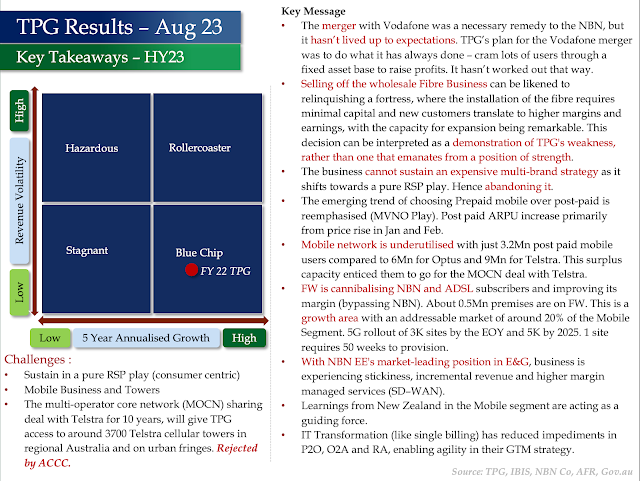
  • The merger with Vodafone was a necessary remedy to the NBN, but it hasn’t lived up to expectations. TPG’s plan for the Vodafone merger was to do what it has always done – cram lots of users through a fixed asset base to raise profits. It hasn’t worked out that way.
  • Selling off the wholesale Fibre Business can be likened to relinquishing a fortress, where the installation of the fibre requires minimal capital and new customers translate to higher margins and earnings, with the capacity for expansion being remarkable. This decision can be interpreted as a demonstration of TPG's weakness, rather than one that emanates from a position of strength.
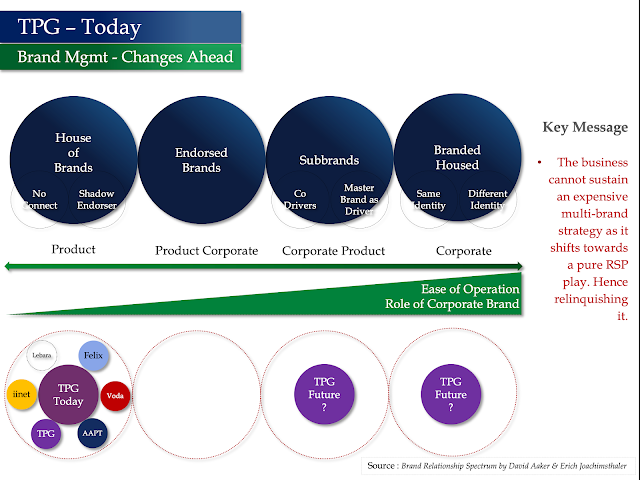
  • The business cannot sustain an expensive multi-brand strategy as it shifts towards a pure RSP play. Hence abandoning it.
  • The emerging trend of choosing Prepaid mobile over post-paid is reemphasised (MVNO Play). Post-paid ARPU increased primarily from the price rise in January and February.
  • The mobile network is underutilised with just 3.2Mn post-paid mobile users compared to 6Mn for Optus and 9Mn for Telstra. This surplus capacity enticed them to go for the MOCN deal with Telstra.
  • FW is cannibalising NBN and ADSL subscribers and improving its margin (bypassing NBN). About 0.5Mn premises are on FW. This is a growth area with an addressable market of around 20% of the Mobile Segment. 5G rollout of 3K sites by the EOY and 5K by 2025. 1 site requires 50 weeks to provision. 
  • With NBN EE's market-leading position in E&G, business is experiencing stickiness, incremental revenue and higher margin managed services (SD–WAN).
  • Learnings from New Zealand in the Mobile segment are acting as a guiding force.  
  • IT Transformation (like single billing) has reduced impediments in P2O, O2A and RA, enabling agility in their GTM strategy.


Why is the Stock Price Flat?

TPG's share price has been flat at $5.47, with a marginal rise of 0.03c after HY23 results on August 24.

The critical reasons for this are:

  • Growth in the Mobile segment because of roaming charges, rationalisation of plans and price increases to combat inflation.
  • Growth in FW bypasses NBN and magnifies the margin.
  • Growth in E&G supplemented by Fibre Fast and EE.
  • The expected sale of the wholesale arm, Vision Stream, is seen as a value creator in the short term. In the longer term, TPG will face severe headwinds to sustain the business because selling a fortress (fibre infra) on which the business is built is not a good move.


  • By focusing on pure RSP play in fixed access, the company has positioned itself as a semi-premium player, similar to Virgin Airlines. This strategic approach enables them to provide cost-efficient services without compromising on customer service. Hence, consolidating all the brands under one umbrella, streamlining their operations and enhancing their overall efficiency. This is uncharted territory for TPG as they will face competition from both high-end and low-end players.
  • In the Mobile segment, they have an underutilised network, hence MVNO play will rise, and they may start exploring other network-sharing deals in the future.
  • TPG is preparing itself for a challenging future.

My previous on NBN Co FY23 Results and its strategic play. 

Source: AFR, TPG, ACCC, ITnews, Reuters, UBS


Monday, August 21, 2023

Brand Value and Positioning Changes in Australia

Brand value and positioning changes in Australia. 

Optus suffered from a data security incident in 2022, while Retailers dominate the top 10 and Auspost ranks surprisingly low. 


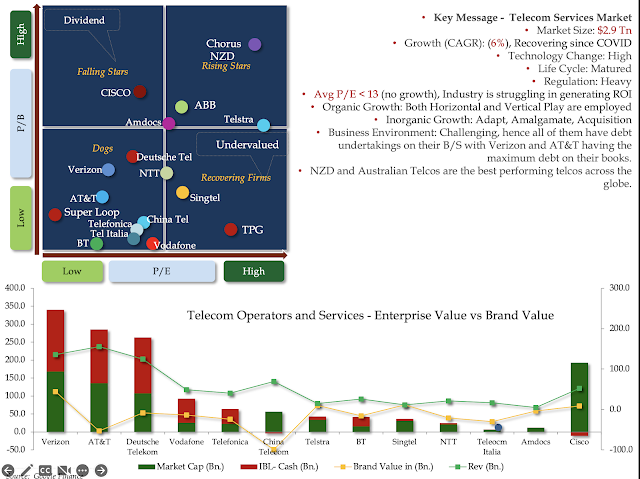
The value of a brand can be calculated from a company's balance sheet and has a significant impact on its financial success. Here are the brand equities of the top telecom players worldwide.


My post on the future of global Telecom and IT players gives good insight.

Saturday, August 12, 2023

Australian Economic Outlook FY2024

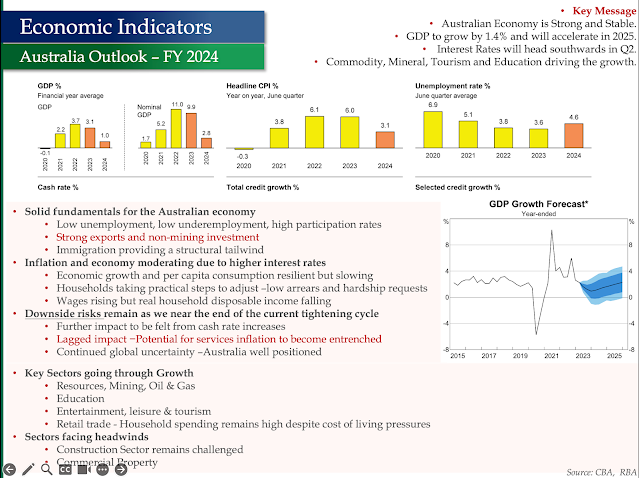
Australian Economic Outlook FY2024 

  • The Australian Economy is Strong and Stable. 
  • GDP is to grow by 1.4% and will accelerate in 2025. 
  • Interest Rates will head southwards in Q2. Commodity, Minerals, Tourism and Education driving the growth.


Friday, August 11, 2023

NBN Co FY 23 Results - Key Takeaways

 NBN Co FY 23 Results - Key Takeaways 

--

  • NBN Co’s Revenue has increased by 4% in FY23 and is facing headwinds for increasing revenue. 
  • CAGR stands at 8.7%. WACC - 3.18% (heading upwards)
  • Has the highest EBITDA margin (68.2%) among telcos globally.
  • Consumer uptake is at a snail's pace, with only 40K net additions in the last 12 months. 
  • 12.3 Mn customers ready to connect 
    • 8.56 Mn are active (30% idle network)
    • 6.64 Mn (78.2%) users are on <= 50 Mbps
    • 2 Mn (24.2%) users < 50 Mbps, 4.52 Mn users on 50 Mbps
    • 1.83 Mn (20.7%) users are on >= 100 Mbps (risen by 2%)
  • 6.6 Mn premises ready for Ultrafast (incl 2.5 Mn on HFC)
    • Poor uptake – only 50-60K has been upgraded
    • In all, 1.83 Mn users are using Ultrafast (>=100 Mbps) internet.
  • Facing heat from Starlink and 5G providers in remote areas
    • Starlink in Australia > 120K subscribers
    • Sky Muster has declined from 108K to 96.1K
  • In the Enterprise 35K EE SIOs are active. 
  • It seeks to improve its top and bottom line by implementing price increases through the SAU. The next revision is to be submitted soon.
  • Today ARPU is $47 (Residential, stagnant), and FY24 ARPU is $49 (sub-SAU approval)
  • Heading for profit (NPAT) without a soft write-off of $32 Bn in H1 FY25. With the write-off, it could be Profitable in FY 24. 
  • NBN’s Enterprise Value has risen from $25 - $19 Bn to $36 - $29 Bn and will be heading northward of $40 Bn if SAU with a price increase is accepted in FY24. A good prospect for the government as it prepares to offload its investment after FY25.  
  • The total cost of ownership TCO of NBN in 2023, using ICRA, is A$76Bn+, and without ICRA consideration, it is >A$59.9BN

--


NBN Co's Total Cost of Ownership (TCO) from 2010 to 2023


  • NBN was established to reduce the digital gap in Australia by making high-speed internet (>100 Mbps) affordable and removing Telstra's monopoly in fixed-line access. While NBN has succeeded in removing Telstra's monopoly, it's disheartening to see that they have failed to reduce digital exclusion by providing affordable high-speed internet.
  • After investing A$76Bn over 14 years, Australia's average fixed internet speed ranks 81st globally at 53 Mbps, lagging behind many other countries in terms of internet connectivity.
  • 75% of Australians are consuming the internet at a speed of 50Mbps or less.


Source NBN Co, AFR, Reuters, ACCC

Friday, August 04, 2023

How Digital Transformation can Transform Energy and Utilities

How Energy and Utilities Can Transform

Response from GenAI tool ChatGPT:

--

The transformation of the energy and utilities sector is a complex and ongoing process driven by technological advancements, environmental concerns, changing consumer expectations, and regulatory changes. This transformation is often referred to as the "energy transition" or "utility transformation." Here are some key ways in which the energy and utilities sector can transform:

  • Transition to Renewable Energy: One of the most significant transformations in the energy sector is the shift from fossil fuels to renewable energy sources like solar, wind, and hydropower. This transition reduces greenhouse gas emissions and promotes sustainability.
  • Decentralisation: Traditional energy systems were centralised, with power generated at large power plants and distributed through a grid. The future of energy includes more decentralised systems, where individual homes and businesses generate their own power through solar panels and wind turbines. This is known as distributed energy generation.
  • Smart Grids: The development of smart grids enables more efficient and reliable distribution of electricity. Smart grids use digital technology to monitor and manage the flow of electricity, optimise energy usage, and integrate renewable energy sources seamlessly.
  • Energy Storage: Advances in energy storage technology, such as batteries, are crucial for the integration of intermittent renewable energy sources. Energy storage helps balance supply and demand, ensuring a stable energy supply even when the sun isn't shining or the wind isn't blowing.
  • Electrification of Transportation: The transportation sector is gradually transitioning from internal combustion engine vehicles to electric vehicles (EVs). This shift creates opportunities for utilities to provide EV charging infrastructure and manage increased electricity demand.
  • Energy Efficiency: Utilities and consumers are placing greater emphasis on energy efficiency measures, from energy-efficient appliances and buildings to industrial processes. This reduces energy waste and lowers overall energy consumption.
  • Grid Resilience: Climate change and extreme weather events pose a threat to energy infrastructure. Utilities are investing in grid resilience to ensure the continued delivery of electricity even in adverse conditions.
  • Customer-Centric Services: Utilities are focusing on improving customer experiences by offering services like real-time energy consumption data, flexible pricing plans, and energy-saving tips through digital platforms.
  • Regulatory Changes: Government policies and regulations play a crucial role in driving energy and utilities transformation. Regulations may incentivise renewable energy adoption, set emissions reduction targets, or mandate energy efficiency standards.
  • Emerging Technologies: The adoption of emerging technologies like blockchain for energy trading, artificial intelligence for grid optimisation, and quantum computing for advanced energy modelling can further transform the sector.
  • Environmental Sustainability: Utilities are increasingly committing to sustainability goals, including reducing carbon emissions and transitioning to carbon-neutral or carbon-negative operations.
  • Community and Microgrids: Smaller-scale energy systems, such as microgrids, can provide localised energy resilience and support communities during power outages.
  • Partnerships and Collaboration: Collaboration between utilities, technology companies, governments, and research institutions is essential to accelerate the transformation and share best practices.

The transformation of the energy and utilities sector is a multi-faceted process that involves various stakeholders, from governments and utilities to consumers and technology providers. It is driven by a combination of economic, environmental, and technological factors, and it will continue to evolve as new innovations emerge and the world seeks sustainable energy solutions

--

Digital transformation is playing a pivotal role in reshaping the energy and utilities sector. It offers innovative solutions to improve operational efficiency, enhance customer experiences, and address sustainability challenges. Here's how digital transformation can transform the energy and utilities industry:

  • Smart Grids: Digital technologies enable the development of smart grids that incorporate sensors, real-time data analytics, and automation. These grids enhance grid management, reduce energy losses, optimise energy distribution, and accommodate renewable energy sources more efficiently.
  • Energy Management and Optimisation: Digital tools and data analytics help utilities better understand and manage energy supply and demand. Predictive analytics can forecast energy consumption patterns, enabling utilities to optimise energy generation and distribution.
  • Grid Resilience: Digital technologies enhance the resilience of energy grids. Predictive maintenance using IoT sensors and analytics can identify potential equipment failures, reducing downtime and improving grid reliability, especially during extreme weather events.
  • Renewable Energy Integration: Digital solutions help integrate intermittent renewable energy sources like wind and solar into the grid. Advanced forecasting, demand response, and grid balancing algorithms ensure a stable and efficient energy supply.
  • Decentralised Energy: Digital platforms facilitate the deployment of decentralised energy solutions like microgrids and peer-to-peer energy trading. Consumers can produce, store, and sell excess energy, leading to more resilient and sustainable energy ecosystems.
  • Customer Engagement: Digital transformation enhances customer engagement through online platforms and mobile apps. Customers can access real-time energy usage data, receive personalised energy-saving tips, and choose flexible pricing plans, promoting energy efficiency.
  • Energy Storage Management: Digital tools monitor and optimise energy storage systems, such as batteries, for grid balancing and peak load management, increasing the reliability of renewable energy sources.
  • Asset Management: Utilities use digital asset management systems to track the performance of infrastructure and equipment. Predictive maintenance based on data analytics reduces downtime and extends the lifespan of assets.
  • Cybersecurity: As digitalisation increases, cybersecurity becomes critical. Utilities invest in cybersecurity measures to protect critical infrastructure from cyber threats, ensuring the security and reliability of the grid.
  • Data Analytics for Sustainability: Digital platforms allow utilities to collect and analyse vast amounts of data related to energy production and consumption. This data is crucial for making informed decisions about sustainability goals, emissions reductions, and resource allocation.
  • Electric Vehicle Integration: Digital infrastructure supports the growth of electric vehicles (EVs). Utilities can offer EV charging stations, manage EV charging load, and provide incentives for off-peak charging.
  • Regulatory Compliance: Digital transformation aids in meeting regulatory requirements efficiently. Utilities can use data analytics to track and report on emissions, energy efficiency, and renewable energy integration to comply with environmental regulations.
  • Energy Market Participation: Digital platforms enable utilities to participate in energy markets more effectively. They can engage in real-time energy trading, offering surplus energy to the grid during peak demand.
  • Workforce Management: Utilities can use digital solutions for workforce management, scheduling, and training to improve field operations and response times.
  • Supply Chain Optimisation: Digital tools assist in optimising the supply chain for equipment and materials used in energy infrastructure projects, reducing costs and lead times.

In summary, digital transformation empowers the energy and utilities sector to operate more efficiently, adapt to changing energy landscapes, reduce environmental impacts, and provide customers with enhanced services and experiences. It plays a vital role in shaping a more sustainable, reliable, and resilient energy future.

--

My post on How Telecoms Can Transform and Why Telcos are Struggling to Generate ROI

Thursday, August 03, 2023

Digital Services Landscape and Opportunity for Telecom in Australia

Exploring the Digital Services Landscape and Opportunities for the Telecom Industry in Australia.


Consumer:
  • Financial Services across Insurance, e-commerce and Fintech have an addressable market of > $100 Bn and Telcos are eager to increase their wallet share to the mid-20s. 
Enterprise: 
  • The potential for growth in areas like IoT and Smart places is immense, with minimal infrastructure investment required in comparison to 5G. 
  •  Private 5G and SD-WAN are currently in high demand across various industries including Mining, Tourism, Energy, Heathcote, and Supply Chain. These verticals are the focus due to their increasing need for advanced technological solutions.

Australia is Lagging in Internet Speed While Price is going Up

Australia is Lagging in Internet Speed While Price is Going Up. 

There are valuable takeaways from New Zealand's fibre optic infrastructure rollout, which boasts faster speeds and more affordable pricing.


Why Australia's Internet services are so expensive compared to other countries. A quick Big Mac Index test reveals why


Source: Comms day

 
AVC - Connection Cost 
CVC - Bandwidth or Capacity Cost
POI - Connection Cost 
POI - One-Off Set-up Fee     

Snippet from the note below. 
Source: TekTel 


Saturday, July 29, 2023

Telecom Industry Australia - IT Opportunity for Software and Service Providers

Mapping of Tech Spend and Technology gives a good view of IT spending in 2023


Mapping of Digittal Services across Consumers and Enterprises gives a good view of Telecom spending in 2023


My Other Post on  -"Telecom Industry Australia - Where the Money will be spent in the next two to three years", can be read here.

Wednesday, July 19, 2023

Why Two Sided Matrix is Still Popular for Strategy and Management Consulting

 Why Two-Sided Matrix is Still Popular for Strategy and Management Consulting  


Source: Mckinsey, BCG, Sales Academy, Forrester


Tuesday, July 04, 2023

Starlinks Growing Presence in Australia - Reducing Digital Divide in Rural Australia

Starlinks' Growing Presence in Australia's Telecom Sector and Transforming Connectivity in Remote Areas. 


Source AFR:

Telstra announced a deal to offer internet and voice calls via Mr Musk’s Starlink service on Tuesday, which uses a constellation of small, lower-orbiting satellites providing faster speeds than the NBN Sky Muster. 

Telstra’s broadband deal with Starlink is non-exclusive, meaning the challenger could still pitch its services to NBN. However, Telstra has exclusivity in providing voice call services through Starlink.

The second-largest Australian telecommunications company announced a deal on Wednesday that will let users access the internet and make calls on their phones via Starlink’s satellites from late 2025. 

Beaming signals from space would also help Optus compete with Telstra’s superior regional tower network. The Optus-Starlink partnership also poses a risk to the NBN Co because the same SIM cards that a phone uses to connect to a satellite could also be used by households for home internet. 

That will only come into play if the capacity is high enough because home internet usage is typically much higher than mobile phone data. 
Standard NBN services used an average of 452 gigabytes of data a month last year, those on fixed satellite connections used 189 gigabytes, while mobile users consumed just 14.5 gigabytes, according to ACCC data. 

 The deal with Starlink was intended to be a new product aimed at mobile phone customers and would not require a new device to connect to the service when they left an area with the signal from ground towers. Asked whether Optus’ deal was exclusive, Mr Williams said: “This is a unique experience that Optus customers will have.” 

 Optus plans to start its Starlink service capacity for text messages in late 2024 before expanding to voice and the internet towards the end of 2025. It has not announced how fast the connections will be, except that they will be transmitted via the latest generation 4G system or their pricing.

Tuesday, June 27, 2023

Negotiation By Earthy Natives and How they Behave as a Seller and Buyer

 Negotiations - Influence to Win

The business-to-business (B2B) sales negotiation is a conversation between a seller and a buyer to reach an agreement beneficial to both. To achieve a zone of potential agreement (ZOPA), both engage in multiple rounds of discussion. The back-and-forth nature of these discussions is driven to gain the upper hand over the other side by finding their reservation point (breaking point), BATNA (Best Alternative To a Negotiated Agreement), and any helpful information that will assist in bargaining.

In sales, to influence and win negotiations, a lot of preparation is required. This includes collecting information about the other side's negotiation style, motivation, risks, BATNA, concession, reservation, and timing. Without preparation and gathering of this information, the chances of winning negotiations are minimal. Sometimes, even after gathering information and practice, negotiations can still be lost or suspended indefinitely because of changes in the political landscape, financial upheaval, change in priority, a pandemic outbreak, or other unseen factors. 

The gathering of information and preparation for negotiations is time-consuming and is often challenging. Elements of nature and their attributes are applied to overcome this difficult task of preparing the groundwork for influencing and winning negotiations.

Let us explore how a seller or a buyer leverages elemental attributes learned in previous sections to position and influence their respective stakeholders with the intent to win.


Earth Natives Negotiation


Earth means Nurture, Clamness and Stability


Negotiation Behaviour 

o they speak slowly with a deep voice
o they are good listeners and have a lot of patience
o fear of failure makes them hide information 
o they lack transparency and principles
o often can be deceptive or employ dirty tricks like psychological warfare and pressure tactics
o they are sluggish in their responses and only respond when necessary 
o they are accommodative and let others take control 

Argument  
o they are emotionless and have an advisory tone
o impresses upon care and nurture during the discussion

Motivation 
o being lazy, they prefer that the status quo is not challenged 

Concession 
o being fixated, they are not open to making concessions easily 

Reservation 
o being secretive, they don't share their reservations easily or like to hide their reservations to use them later in the bargaining mix     

Positioning 
o they are driven by the status quo instead of being disruptive

Risk Appetite
o is moderate (ref: risk rating is 'moderate') 
o hard to find gaps in their risk mitigation strategy, the opposite side will find it challenging to take advantage  

Secrecy
o they are highly secretive
o they hide information and details   

Information Gathering
o they are good at gathering information
o they rely on their friends or social circle

Preparation 
o fear of failure drives them to prepare thoroughly; attention to detail is good

Objection Handling
o they are open to grievances and will listen patiently
o objection mitigation is primarily anchored at themes like delivery, reliability, care and nurturing

Time  
o they are fixated on their anchoring, cherish long-drawn negotiations
o they use time as a means of bargaining   

Comms Style
o they are slow in communication and respond at their own pace 
o they are good listeners
o they are structured and semantically driven
o they speak with gravitas and purpose and carry a deep voice 

BATNA
o they are secretive and don't open up in conversations 
o they prefer to have alternatives or options 

Price

Reservation and Target Price 
their secretive nature makes it nearly impossible to know their price range or preference 
they are good at disguising their intentions 

Offers 
they prefer multiple offers to negotiate, which keeps the other side guessing; it's a grind for the opposite side 
fond of hoarding means bundling pricing with freebies will appeal to this type of buyer      

Environment To Influence 
o being lazy, they prefer an indoor environment or a place with a relaxed setting, like to have friends or supporters during the conversation, earthly natives prefer to hoard things so giving freebies (e.g., from marketing events) can assist in influencing


More can be read in the book at
 amazon.com


Monday, June 26, 2023

Sellers from Mars and Buyers from Venus - Negotiations by a Attractive and Action Centric Seller and Buyer

Negotiations - Influence to Win

The business-to-business (B2B) sales negotiation is a conversation between a seller and a buyer to reach an agreement beneficial to both. To achieve a zone of potential agreement (ZOPA), both engage in multiple rounds of discussion. The back-and-forth nature of these discussions is driven to gain the upper hand over the other side by finding their reservation point (breaking point), BATNA (Best Alternative To a Negotiated Agreement), and any helpful information that will assist in bargaining.

In sales, to influence and win negotiations, a lot of preparation is required. This includes collecting information about the other side's negotiation style, motivation, risks, BATNA, concession, reservation, and timing. Without preparation and gathering of this information, the chances of winning negotiations are minimal. Sometimes, even after gathering information and practice, negotiations can still be lost or suspended indefinitely because of changes in the political landscape, financial upheaval, change in priority, a pandemic outbreak, or other unseen factors. 

The gathering of information and preparation for negotiations is time-consuming and is often challenging. Elements of nature and their attributes are applied to overcome this difficult task of preparing the groundwork for influencing and winning negotiations.

Let us explore how a seller or a buyer leverages elemental attributes learned in previous sections to position and influence their respective stakeholders with the intent to win.

Fire Natives Negotiation

Fire means Action and Excitement


Negotiation Behaviour  

o fire represents the heart, so these natives interact with honesty and openness; the sharpness of fire is reflected in their sharpshooting style conversation

o they have no hidden agenda and lose their cool if the opposite side is not transparent

o they lack depth in conversation 

o they use charm to impress upon others

o they are competitive and like to take control of the conversation 

Argument

o fire being sharp, they are data-driven and emotionless

Motivation

o to get the limelight from winning a deal or to be seen as visionary 

Concession 

o they are open and transparent in making concessions through the bargaining mix

Reservation

o they are open and willing to share their own reservations during the conversation with the other side

Positioning 

o futuristic and innovative, new beginnings or new business

Risk Appetite 

o is higher

o gaps can be found in their risk mitigation approach, and the opposite side can identify these gaps to negotiate

Secrecy 

o being impulsive and talkative, it's tough for them to hide information   

Information Gathering

o they are not research-driven, so they struggle with information gathering

Preparation

o they are impulsive and always appear to be in a hurry; thus, they miss attention to detail and often lack comprehensiveness in their preparation

o they rely on their charm and brilliance

Objection Handling 

o they are open to grievances

o they don't address the root cause of the objection because they lack depth and are impulsive

o they get emotional and angry on too many objections 

o their objection mitigation is anchored at themes like innovation and opening new revenue stream

Time

o being agile and impatient, they prefer to wrap up negotiations swiftly 

o they don't use time as a means of bargaining 

Comms Style 

o they are swift and use strong words

o they prefer lots of visuals and data

o they respond immediately and expect the same from the opposite party 

o they are prone to making mistakes 

BATNA

o because they open up in conversations quickly; therefore, they end up sharing information with the opposite side

o it's difficult for them to leverage this option (to use an alternative)

o they often prefer not to apply BATNA 

Price

Reservation and Target Price their openness and purity make it hard to hide this information from the opposite side; therefore, they end up signalling their range or preference and letting the opposite side gain higher bargaining spread

Offers - don't believe in the multiple or back-and-forth nature of making an offer; they prefer to make one or two offers only

Environment To Influence 

o fire requires air (oxygen) to ignite and spread; therefore, an external environment or a well-ventilated indoor environment is preferred for influencing a fiery native


More can be read in the book at amazon.com


Friday, June 23, 2023

Next Generation Digital Transformation - Beyond Analog and Digital Revenue to Digital Commerce

Next Generation Digital Transformation - Beyond Analog and Digital Revenue to Digital Commerce

-


My Previous POV from 2012 on First Generation Digital Transformation
-


Thursday, June 22, 2023

Wednesday, April 05, 2023

How Australian Telcos are Outperforming their Global Peers

How Australian Telcos are Outperforming their Global Peers 


Globally, telecom players are facing cut-throat competition from various players across Tier 1-3 operators and OTT players. Here in Australia, there is an Oligopoly of operators across fixed lines and mobile, hence services are expensive and they command better margins on their services.

Enterprise Value and Market Cap. of NBN in Jan 2023 - Without deferring the debt of $32 Bn.

  • If NBN is sold today, it will get around $24 - $26 Bn, and that is less than what the Govt has infused as equity ($29.5 Bn).


Other Key Points:
  • With the highest EBITDA Margin among the major Telecom Players in Australia, keen to know why the wholesale price can't be reduced, esp when Govt has deferred $32Bn in debt and, in effect, IBL is only for $12 Bn. 
  • With the change in direction of NBN rollout from Economies of Scope to Economies of Scale, NBN will benefit across the value chain. Benefits in terms of product rationalisation, workforce harmonisation,  vendor consolidation, IT simplification, and more.
  • IT will benefit from this shift by reducing the OPEX profile enabled by simplicity, standardisation of data, and boundary-less information flow. The new CIO has the depth and expertise in the IT and Telco domains to make this transition swiftly. 
EBITDA Margin and Volatility of Stock 


NBN has the maximum EBITDA Margin, and NTT has the least. Operators with the least margin and with struggling operations will have declining OPEX dollars and will free up Cash for digital transformation dollars. Hence, the Vendors will target them.

Verizon and Telstra are the least volatile stocks, whereas NTT and CISCO are the most volatile. Stocks with less volatility are good candidates for dividend earnings and have stable market conditions, where long-term initiatives can be executed.

IT Services Opportunity in Telecom - 2023